
How to Size and Select Industrial Solar Inverters for Commercial Rooftops in Bangladesh
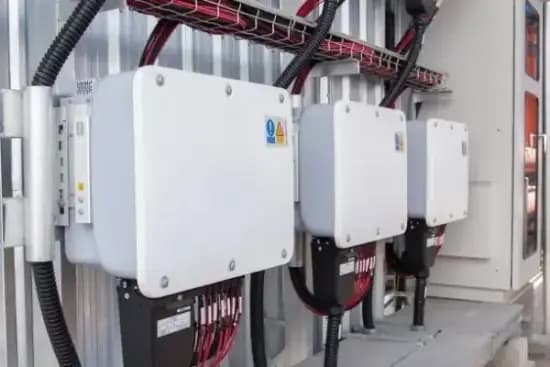
Sizing Industrial Solar Inverters for Commercial Rooftops in Bangladesh
Commercial and industrial solar installations require precise matching between the photovoltaic (PV) DC array generation profile and the inverter's AC conversion capability. Selecting the optimal inverter topology directly impacts levelized cost of energy (LCOE) and 25-year reliability.
Direct Answer (BLUF): What Inverter Loading Ratio (ILR) is Recommended for Bangladesh?
Engineering Rule of Thumb: For commercial rooftops in Bangladesh, design your system with an Inverter Loading Ratio (ILR) of 1.15x to 1.25x DC-to-AC. Because high ambient summer heat (up to 40°C) and monsoon cloud diffuse light reduce instantaneous panel peak wattage, oversizing the DC array ensures the inverter operates at its maximum 100% AC output for significantly more hours each day, maximizing total daily kWh yield.
1. Inverter Loading Ratio (DC-to-AC Sizing)
In Bangladesh's tropical maritime climate, solar panels rarely operate at Standard Test Conditions (STC: 25°C cell temperature, 1000 W/m² irradiance). Operating cell temperatures in Gazipur, Savar, and Chittagong reach 60°C to 70°C, reducing voltage and output power.
- Sizing at 1.20x ILR: A 100 kW AC inverter paired with a 120 kWp DC solar array will reach maximum AC power output earlier in the morning (around 9:30 AM) and maintain it until later in the afternoon (around 3:00 PM).
- Clipping Losses vs. Energy Gain: Any minor clipping losses during the peak 45 minutes of solar noon are vastly outweighed by the 8% to 14% net gain in total daily energy (kWh) production.
2. Maximum Power Point Tracking (MPPT) Layout & Voltage Windows
Industrial rooftops in Bangladesh frequently feature roof vents, turbo ventilators, fire stairs, and multi-directional pitches:
- Multiple Independent MPPTs: Modern commercial string inverters (50kW to 125kW) provide 4 to 10 independent MPPT trackers, allowing you to isolate shaded strings without degrading the power of unshaded sections.
- MPPT Operating Voltage Window: Design string lengths such that minimum string voltage on the hottest summer day ($V_{mp} \text{ at } 70^\circ\text{C}$) stays strictly within the full-load MPPT range (typically 500V–850V DC).
| Engineering Parameter | Recommended Specification | Operational Benefit in Bangladesh |
|---|---|---|
| DC/AC Overloading | 1.15x – 1.25x | Maximizes daily kWh energy generation |
| MPPT Full-Load Range | 500V – 850V DC | Ensures peak conversion efficiency (> 98.6%) |
| Ingress Protection | IP66 Enclosure | Shields electronics from industrial textile lint, dust, and driving monsoon rain |
| Cooling Topology | Smart Forced Air Cooling | Prevents premature thermal derating at 45°C ambient temperature |
| Grid Code Compliance | IEC 62116 / IEEE 1547 | Guarantees anti-islanding trip in < 2.0s for utility safety |
3. String Inverter vs. Central Inverter Comparison
| Comparison Metric | Multi-MPPT String Inverters (e.g. 50kW–125kW) | Central Inverters (e.g. 1MW–2MW Skids) |
|---|---|---|
| Rooftop Suitability | Exceptional (Lightweight, distributed wall/strut mount) | Poor (Requires heavy concrete pad, massive DC cabling) |
| Failure Redundancy | High (If 1 unit trips, remaining 90% of plant runs) | Low (Single failure takes down entire 1MW array) |
| MPPT Granularity | 4 to 10 MPPTs per unit (Adapts to varied roof slopes) | 1 to 2 MPPTs (Suffers high mismatch losses) |
| O&M Replacement | Swap unit in 2 hours locally | Requires specialized high-voltage factory engineers |
4. Commercial Solar Inverter Pricing in Bangladesh (2026 Benchmarks)
| Inverter Power Rating | Topology & Phasing | Number of MPPTs | Approx. Wholesale Price (BDT) | Warranty Terms |
|---|---|---|---|---|
| 10 kW String Inverter | 3-Phase 400V On-Grid | 2 MPPTs | BDT 1,20,000 – 1,45,000 | 5 Years standard (extendable to 10) |
| 20 kW String Inverter | 3-Phase 400V On-Grid | 2 MPPTs | BDT 1,65,000 – 1,95,000 | 5 Years standard |
| 30 kW String Inverter | 3-Phase 400V On-Grid | 3 MPPTs | BDT 2,15,000 – 2,50,000 | 5 Years standard |
| 50 kW Industrial Inverter | 3-Phase 400V On-Grid | 4 to 5 MPPTs | BDT 2,90,000 – 3,40,000 | 5 Years standard |
| 100 kW Industrial Inverter | 3-Phase 400V On-Grid | 8 to 10 MPPTs | BDT 4,60,000 – 5,30,000 | 5 Years standard |
| 125 kW Heavy-Duty Inverter | 3-Phase 400V / 480V On-Grid | 10 MPPTs | BDT 5,40,000 – 6,20,000 | 5 Years standard |
5. Frequently Asked Questions (AEO / FAQ)
Q1: What happens if an inverter gets too hot during Bangladeshi summers?
Answer: High-quality inverters utilize smart thermal derating. If internal heat sink temperatures exceed 75°C (due to 45°C ambient air), the inverter smoothly derates output power by 5%–10% rather than shutting down. Always install inverters under a sunshade canopy with adequate natural ventilation.
Q2: What communication interfaces are required for factory net-metering monitoring?
Answer: Modern commercial inverters must provide RS485 Modbus and 4G / Wi-Fi telemetry dongles. These transmit real-time voltage, current, power, and daily kWh generation to a cloud portal and enable zero-export limitation when required.
Need Commercial Equipment for Your Project?
Get manufacturer-direct wholesale pricing, complete compliance documentation, and Dhaka warehouse delivery lead times.