
Commercial Solar String Design in Bangladesh: Modules per String, Temperature Limits and the MPPT Window
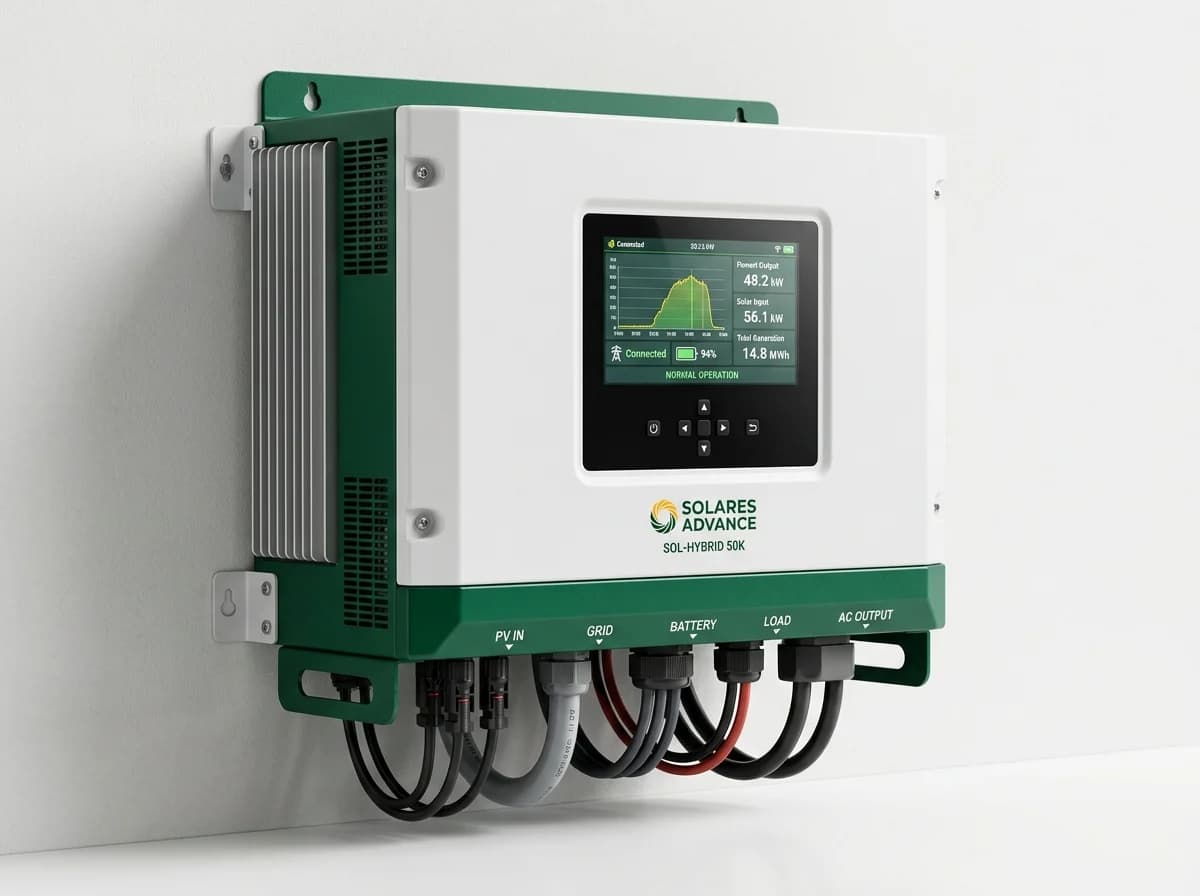
Direct answer: A commercial PV string is sized by two temperature-corrected limits, not by the module count that fits the roof: the maximum modules per string is set by the open-circuit voltage (Voc) at the site's coldest temperature staying below the inverter's absolute maximum DC voltage, and the minimum is set by the maximum-power voltage (Vmp) at the hottest cell temperature staying above the inverter's minimum MPPT voltage. Design every string between those two numbers, keep different orientations and shade patterns on separate MPPT inputs, and never copy a string length from another project's datasheet.
Why STC numbers alone will mislead you
Module datasheets quote Voc and Vmp at Standard Test Conditions: 25 °C cell temperature and 1,000 W/m2 irradiance. A Bangladeshi rooftop is almost never at 25 °C. On a cool, clear winter morning the cells may sit near 5-10 °C, and voltage rises as temperature falls — the Voc temperature coefficient is negative, typically around -0.28% per °C. On a hot summer afternoon the cells may reach 65-75 °C, and voltage falls by roughly 0.35-0.40% per °C for Vmp. A string designed only from STC figures is therefore too long on a cold morning (risking an overvoltage trip, or worse, damage beyond the inverter's maximum input) and too short on a hot afternoon (falling out of the MPPT window, so the inverter stops tracking maximum power and output sags).
The governing standard is IEC 62548, which sets out PV array design requirements including DC wiring, protection, switching and earthing; the same temperature-correction method appears in NEC 690.7 and in every inverter manufacturer's string-sizing tool. The formulas are simple:
Voc at coldest temperature = Voc (STC) x [1 + beta-Voc x (Tmin - 25)]
Vmp at hottest temperature = Vmp (STC) x [1 + beta-Vmp x (Tcell-max - 25)]
where beta is the temperature coefficient in % per °C (a negative number), Tmin is the lowest expected cell temperature and Tcell-max the highest. Then:
Maximum modules per string = floor(inverter maximum DC voltage / Voc at coldest temperature)
Minimum modules per string = ceil(inverter minimum MPPT voltage / Vmp at hottest temperature)
Worked example: a 1,100 V string inverter in Bangladesh
Take a modern 550-650 W module: Voc 49.5 V, Vmp 41.2 V, beta-Voc -0.28% per °C, beta-Vmp -0.38% per °C. Pair it with a commercial string inverter rated 1,100 V maximum DC input and a 200-1,000 V MPPT range. For Bangladesh, use a coldest cell temperature of 5 °C (a clear winter dawn in the north) and a hottest cell temperature of 70 °C (a sun-baked dark roof in May).
Maximum length (cold check): Voc at 5 °C = 49.5 x [1 + 0.0028 x (25 - 5)] = 49.5 x 1.056 = 52.3 V per module. Maximum modules = floor(1,100 / 52.3) = 21. A 22-module string would reach about 1,150 V on that cold morning — above the inverter's limit.
Minimum length (hot check): Vmp at 70 °C = 41.2 x [1 - 0.0038 x (70 - 25)] = 41.2 x 0.829 = 34.2 V per module. Minimum modules = ceil(200 / 34.2) = 6. A string shorter than 6 modules would fall below the MPPT minimum on a hot afternoon and stop tracking properly.
So the valid window is 6 to 21 modules — wide, but the sensible design sits in the upper-middle of it. A 20-module string operates near 824 V at STC, comfortably inside the MPPT range in normal weather, with margin at both extremes; it also keeps the string current at one module's Imp, which is what the inverter's per-MPPT current limit is checked against. A 6-module string is legal but fragile: one shaded module, one hot afternoon, and it is out of the window. In practice, commercial designers pick 16-21 modules for 1,100 V inverters and 24-28 for 1,500 V systems, then verify against the actual module and inverter datasheets — never the other way round.
The four checks beyond string length
Length is necessary but not sufficient. A complete string design also verifies:
- Current per MPPT input. The inverter's maximum input current per MPPT, and its maximum short-circuit current, must exceed the parallel strings' combined Isc (with the 1.25 safety factor from IEC 62548 / NEC 690.8). Putting three high-current strings on one MPPT input rated for two is a design error that shows up as clipping on every sunny day.
- One orientation, one MPPT. Strings facing different directions, or with different tilt angles, produce different voltages and currents; paralleling them on one MPPT forces a compromise operating point and wastes energy. Give each orientation its own MPPT input. The same rule applies to shade: a string that sees the parapet shadow at 4 pm must not share an MPPT with an unshaded string, as our shading analysis guide explains — one shaded cell can limit a whole string, and a mixed MPPT spreads that loss further.
- Startup voltage, not just MPPT minimum. Many inverters need a higher voltage to wake up than to keep tracking. If the string's hot-morning voltage sits between the startup threshold and the MPPT minimum, the inverter starts late and loses the first hour of generation on hot days. Check the startup figure on the datasheet, not just the MPPT range.
- Cable and protection to match. String length sets the route length, and route length sets the voltage drop — the string circuit should stay under 2% drop, as our DC cable sizing guide shows. Fuse and isolator ratings follow from the string Isc and the inverter maximum, and mixed-brand MC4 connectors remain a fire risk regardless of how good the string math is, as our fire safety guide explains.
When there is no valid string length
Sometimes the two limits collide: the cold check says 26 modules maximum, the hot check says 27 minimum, and no integer satisfies both. This is a real outcome, not a calculation error — it happens with high-voltage modules on inverters with narrow MPPT windows. The honest fixes, in order, are: choose a module with a smaller voltage temperature coefficient; choose an inverter with a wider MPPT range; or accept a small, quantified hot-day curtailment (often under 0.2% of annual energy) with the shorter string. What is not acceptable is silently ignoring one limit — an overvoltage trip on a cold morning is an inverter fault, and a string that drops out of MPPT every summer afternoon is a permanent yield loss. Either way, the string schedule — every string's module count, orientation, MPPT assignment and calculated voltages — should be a signed document in the handover file, alongside the electrical tests in our commissioning and handover checklist, so that a future expansion or fault investigation starts from the real design, not a guess.
String design is a half-page calculation that protects a 25-year asset. Done at the design table, it costs nothing; discovered on the roof, it costs strings, inverters, or both — and it quietly taxes every kilowatt-hour the plant will ever produce.
FAQs
How many modules can I put in one string?
It depends on the module and the inverter, not on a fixed number. Calculate the maximum from the cold-temperature Voc against the inverter's maximum DC voltage, and the minimum from the hot-temperature Vmp against the MPPT minimum voltage. For a typical 1,100 V commercial inverter with 49.5 V Voc modules in Bangladesh, the window is roughly 6 to 21 modules, with 16-21 the sensible design range.
Why does cold weather raise string voltage?
The Voc temperature coefficient is negative (about -0.28% per °C), so voltage rises as cells cool. A module rated 49.5 V at 25 °C reaches about 52.3 V at 5 °C — a 5.6% rise. A string that fits the inverter limit at STC can exceed it on a cold winter morning, which is why the maximum-length check must use the coldest expected temperature.
What happens if a string falls below the MPPT minimum on a hot day?
The inverter can no longer track the maximum power point, so output drops or the inverter stops producing until voltage recovers. This is most likely on hot afternoons with short strings. Designing the minimum length from the hot-temperature Vmp (around 70 °C cell temperature in Bangladesh) prevents it.
Can I mix orientations or shaded and unshaded strings on one MPPT?
No — different orientations and shade patterns produce different voltages and currents, and a shared MPPT tracks a compromise point that wastes energy from both. Give each orientation and each distinct shade pattern its own MPPT input, and keep string lengths consistent within a paralleled group.
What do I do if no string length satisfies both limits?
Pick a module with a smaller voltage temperature coefficient, pick an inverter with a wider MPPT range, or accept a small quantified hot-day curtailment with the shorter string. Never ignore one limit: overvoltage risks inverter damage, and chronic MPPT dropout is a permanent yield loss. Record the decision in the string schedule.
Sources: IEC 62548 (PV array design, DC wiring, protection, switching and earthing); NEC 690.7 (maximum voltage, temperature-corrected Voc) and NEC 690.8 (1.25 x Isc design current); string-sizing method — maximum modules = inverter maximum DC voltage / Voc at coldest temperature, minimum = MPPT minimum / Vmp at hottest temperature (cell temperature up to about 70 °C for rooftop checks); worked example figures — module Voc 49.5 V, Vmp 41.2 V, beta-Voc -0.28%/°C, beta-Vmp -0.38%/°C; inverter MPPT window and startup-voltage concepts from manufacturer string-sizing guidance.
Need Commercial Equipment for Your Project?
Get manufacturer-direct wholesale pricing, complete compliance documentation, and Dhaka warehouse delivery lead times.